I have always been very passionate about teaching and outreach in academia. Since middle school, I have enjoyed helping others learn and figuring out the best ways to explain concepts. To me, teaching is one of the best ways to give back in academia and it is always a joy to see others become interested in the work that we do as astronomers.
Teaching at UT
I was lucky to twice be the teaching assistant for UT Austin’s Search for Extraterrestrial Life course taught and designed by Dr. Caroline Morley. This is one of my most favorite courses I have ever been involved with! Particularly because of the setup: it was taught in an interactive classroom, where students sat in tables of 6 and lectures were coupled with group activities to spark conversation and communal learning.
In the course, we established a background knowledge of life as we know it on Earth before exploring the potential habitability of other places in the galaxy and the methods through which we could detect it. This journey spans places from our neighbors in the solar system to the wide variety of exoplanets discovered to date, and types of life from microscopic organisms to intelligent extraterrestrials.
During these two semesters of TAing, I designed lectures and group activities for 3 class periods:
- The first two lessons covered the moons of Jupiter and Saturn to discuss their properties, habitability potential, and missions that could go and learn more about the systems (icy moons are the best!):
- Lesson 1: covers the Galilean moons of Jupiter, discussing tidal heating and focusing on Europa. The activity is designed to help students connect the Jovian moon propeties to previously discussed topics about Earth (such as geologic activity and magnetic fields) and the requirements for life. Here are links to the activity and lecture.
- Lesson 2: covers Saturn’s moons, focusing on Enceladus and Titan. The activity ties together both lessons’ information about the icy moons and their habitability potential to teach the students about 6 mission concepts to Jupiter or Saturn with aims to learn about the moons and/or search for life. Taking advantage of the interactve classroom, each table discussed the various missions and was tasked with selecting which mission to fund. Here are links to the activity and lecture.
- The third lesson covered SETI (the search for extraterrestrial intelligence), including its history, goals, methods, and whether or not we would actually want to communicate with an alien civilization (and what to do if we did!) The activity gives the students the Arecibo message, which is an actual signal we have beamed into space, to “decode” without any context, to highlight the difficulties in communicating with an alien species. Here are links to the activity and lecture
Teaching at SUNY Geneseo
While an undergrad, I was an instructor for the lab portion of the introductory astronomy course. One of the privileges of going to an undergrad-only institution was this opportunity to directly teach my own section of a course. During my years there were three different lab courses offered: an intro course covering the solar system (ASTR 106), one covering stars and galaxies (ASTR 111), and one covering all material (ASTR 101). I ran my own section of the lab class, organized pre-lab lectures and quizzes, graded, and of course helped students learn while doing the lab activities.
I also was a tutor at the Physics Learning Center, which provided free tutoring for students in introductory major and non-major physics classes.
Outreach
Astronomy on Tap
Astronomy on Tap is a show that brings astronomy to the public with accesible and fun lectures at a bar, with events happening worldwide!
Before the COVID pandemic, Astronomy on Tap in Austin (AoTATX) ran monthly shows featuring 3 talks and an Astronomy in the News segment, regularly reaching audiences of over 200 people. Throughout 2020, we broadcasted virtual live shows featuring a pared down run of the show. In exciting news, AoTATX has returned to live shows as of November 2023!
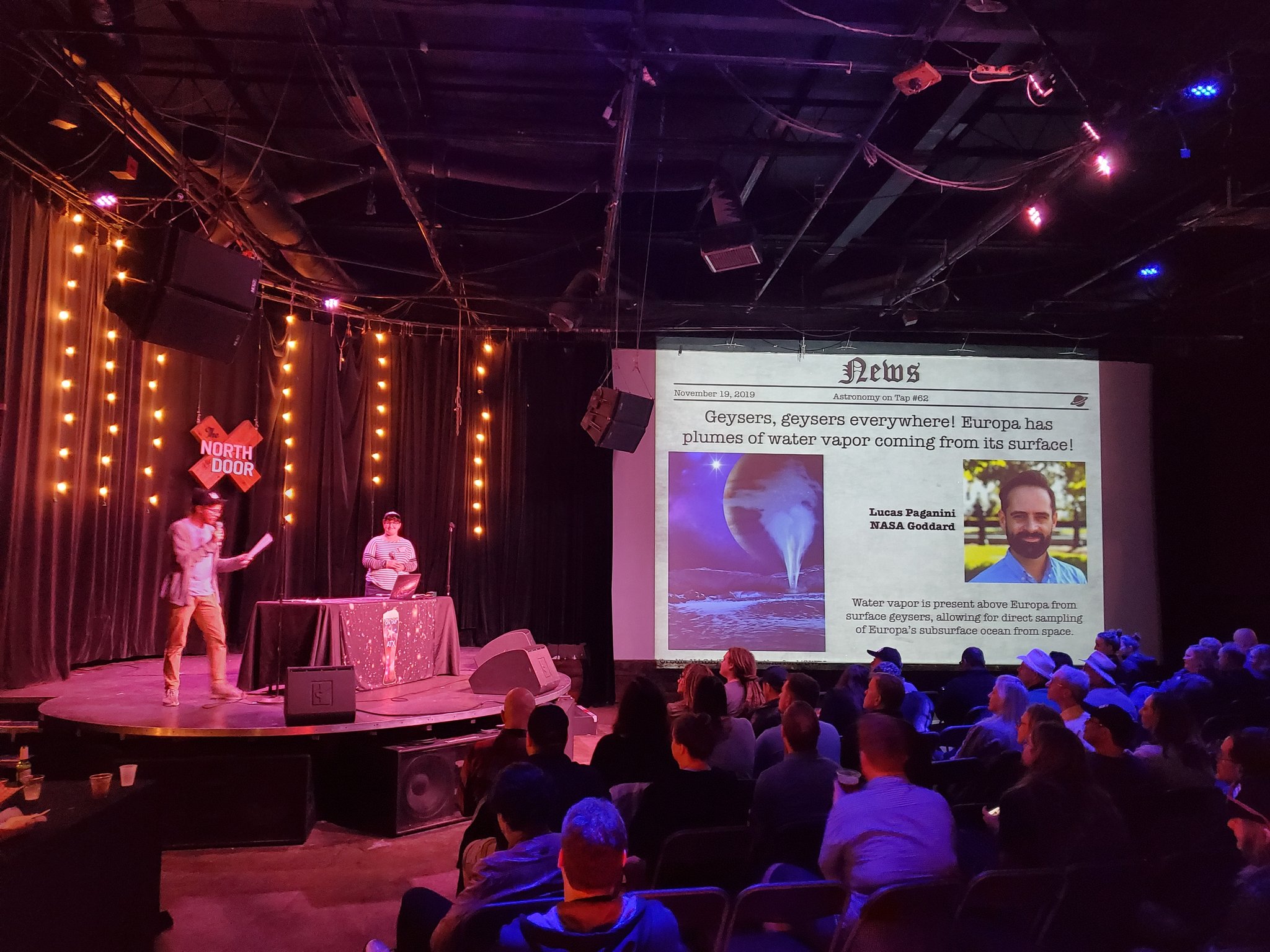
While at UT Austin, I helped to run AoTATX, including helming the Twitter account during our show and co-hosting the Astronomy in the News section with my wonderfully hilarious co-host and fellow grad student Jackie Champagne. The picture on the right captured me and my favorite pasttime: sharing news on the icy moons of the outer solar system. AoT has been a great way of getting astronomy to the public, and the enthusiasm and interest among our audience for all of the topics we cover is palpable.
I have given a few talks at Astronomy on Taps so far. In Austin I gave talks on the prospects of life in the subsurface ocean of Saturn’s moon Enceladus and one on the Dragonfly mission to Titan (and why Titan might very well be the coolest moon in the solar system). Both my first and second talks are available to watch on Youtube! Also, take a look at any of the virtual live shows from 2020 for the monthly comedy routine that is Astronomy in the News. More recently, I was lucky to be invited for a talk at Astronomy on Tap at the Grand Canyon in July 2026 explaining extreme precision radial velocity measurements and how we use them to understand exoplanets.
Thankfully, the news comedy routine tour continued at Space Drafts, which is the Astronomy on Tap event in Tucson. While we were both at Steward Observatory, Jackie and I sporadically brought the news to the Tucson audience since Spring 2023.
Undergraduate Mentoring
At Steward Observatory, I co-mentored undergraduate researcher Suhani Surana with my fellow postdoc Leonardo Paredes, working on NEID data and software to diagnose calibration observations. Suhani is now a first year graduate student at Steward.
While at UT, I was an informal mentor for mulitple undergradute programs:
- The GUMMY program (Graduate-Undergraduate Mentorship in astronoMY), which was a department specific program that matched astronomy undergraduates with grad students to help them navigate the world of astronomy and academia.
- The TAURUS program, which was a summer research experience at UT for undergraduate students from underserved and traditionally marginalized groups. As a mentor, I was paired with one of the TAURUS students to help them with their research, provide advice for career paths after graduation, and welcome them into our department.